Hybrig · The render farm
One shot. Every brand on it.
Four scenes above. One camera move each. Every company on screen is a real business with their real artwork welded to the surface — and all four panels change company on the same frame.
A video model cannot do this, and it is not close.
Ask a generative model to put a company’s logo on a truck and it draws something logo-shaped. The letters garble, the colours drift, and it comes out different on every run. It is never quite their mark — and “that is nearly your logo” is not a pitch.
This is the opposite arrangement. The shot is generated once, with the surface left blank. After that the artwork is theirs — the actual file, at full resolution, composited onto the surface and carrying the light gradient sampled off the clay underneath it. Nothing is redrawn, so nothing can drift.
The assembly line
Five steps, and only the first one needs a human.
Every picture below is a real frame out of a real batch — the traced box, the solve, the swing, the clay. None of it is a mock-up.
- 01
You draw one box. That is the only thing it asks you.
Four corners on a single frame, on whatever surface should carry the brand — a truck door, a yard sign, a tablet on a kitchen table. Corners rather than a rectangle, because a panel seen at an angle is a trapezoid, and artwork stretched onto a rectangle warps. Four corners is also exactly what the maths needs, so nothing has to be guessed later.
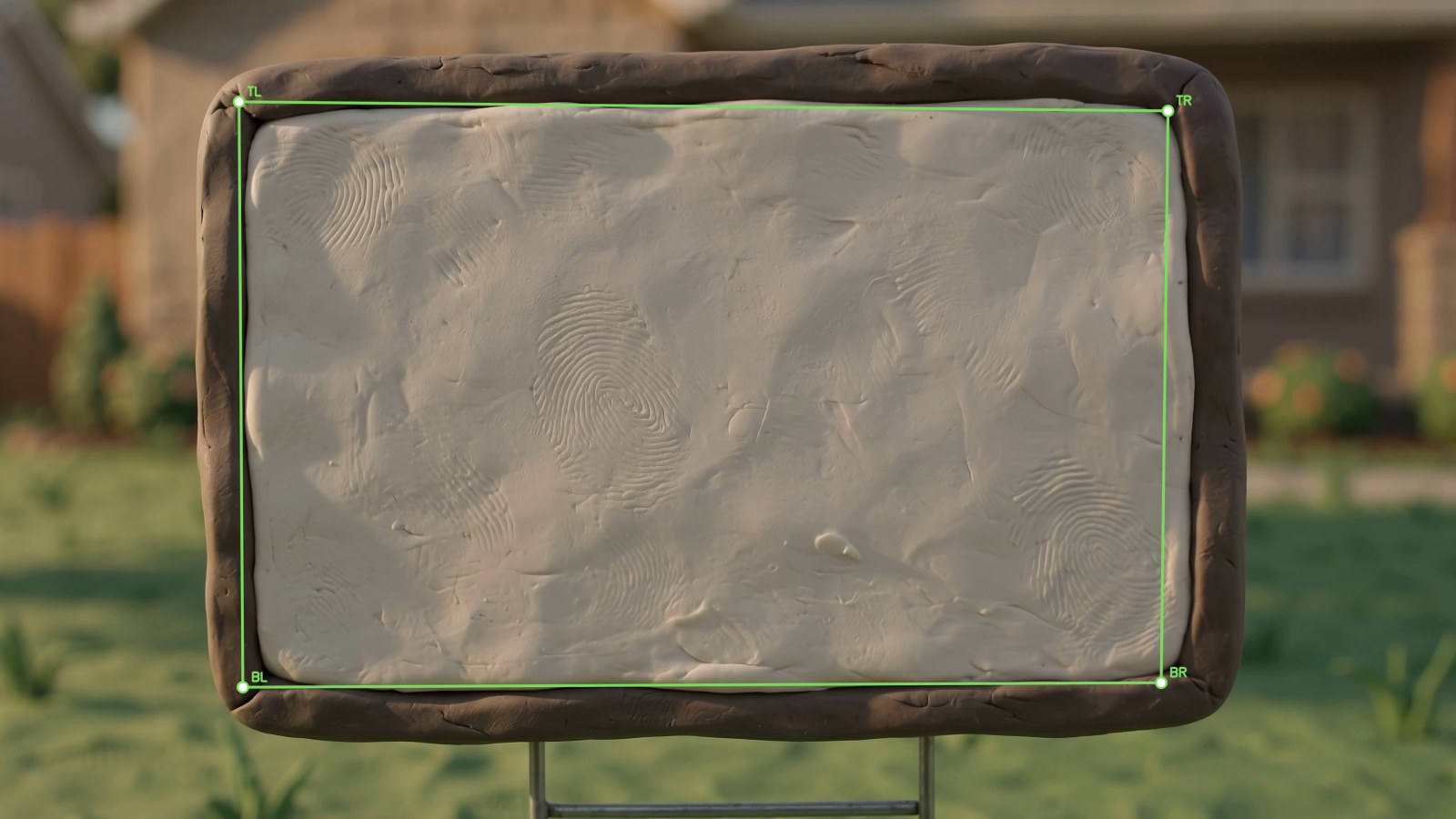
The green box is the real traced quad, on the real plate. - 02
Then it measures whether that surface actually moves.
This is the step everyone skips, and skipping it is what ruins the shot. Tracking a surface that is standing still makes things worse, not better: smooth clay has almost no texture, so the solve grabs onto render noise and throws the logo around. This yard sign travels a long way and needs a real solve. A locked-off panel does not — a fixed pin is exact by construction and costs nothing. You are never asked a question you could not answer by looking at a frame.
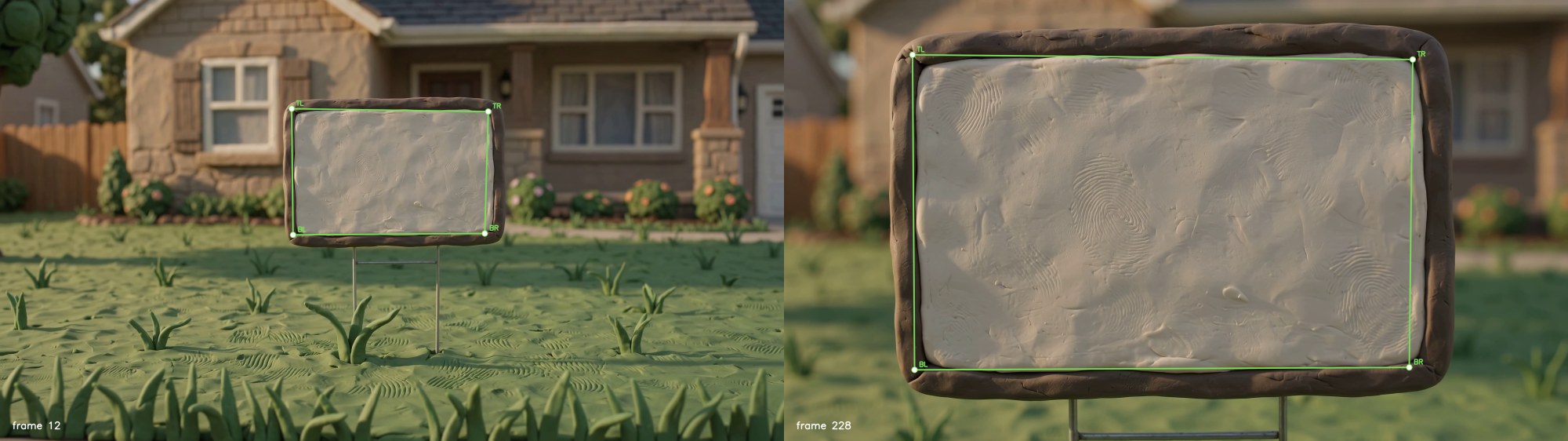
Same box, start and end of the shot. - 03
It solves only what moves — every frame, against one reference.
Not neighbour to neighbour. Chaining frames lets a small error compound quietly until the logo has slid off the panel, and nothing in the process ever flags it. Every frame is measured against a single reference frame instead, so error cannot accumulate, then smoothed with a centred window so the artwork rides the surface without arriving late. Here the truck door swings fully open and the mark stays welded to the door rather than sliding onto the body.
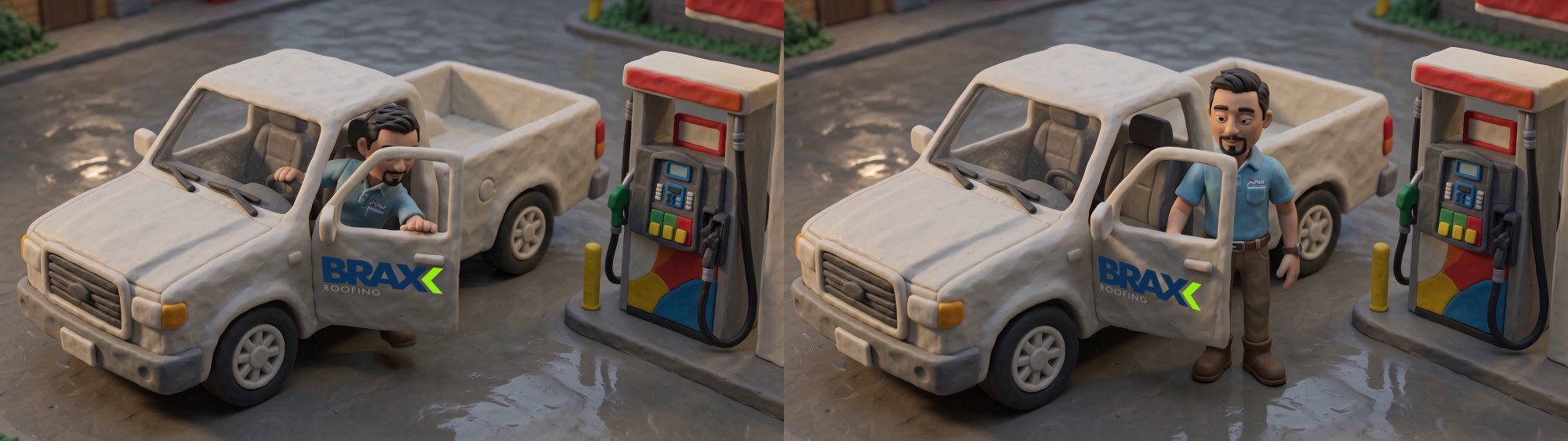
Door open. Logo still on the door. - 04
The artwork picks up the light falling across the surface.
A logo pasted on flat reads as a sticker. Dropping its opacity does not fix that — it just looks faded, translucent rather than printed. So the brightness across the panel is sampled off the plate and multiplied into the artwork instead: darker where the surface falls into shadow, brighter where the light catches it, following the same broad gradient as the clay around it. It is a lighting gradient, not a physical relight — one soft map, not a simulation of the surface.
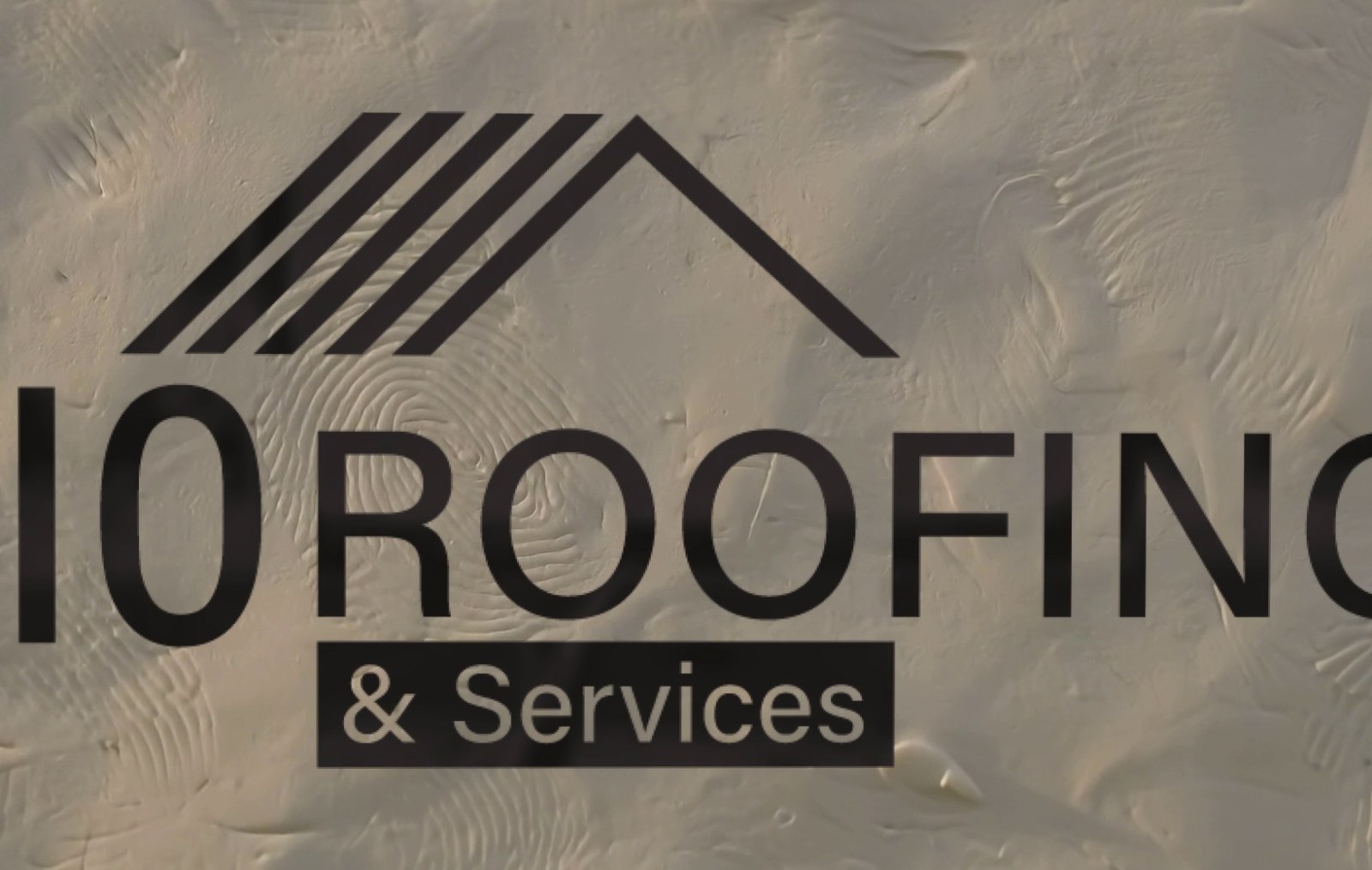
Carrying the surface's light gradient. - 05
Then it farms. The hundredth costs what the first one did.
Point it at a folder of logos and every one becomes its own finished video — full resolution, carrying the original audio, carrying the same light gradient. This is the step that turns a nice shot into a campaign: the solve is the expensive part, and it only ever happens once.
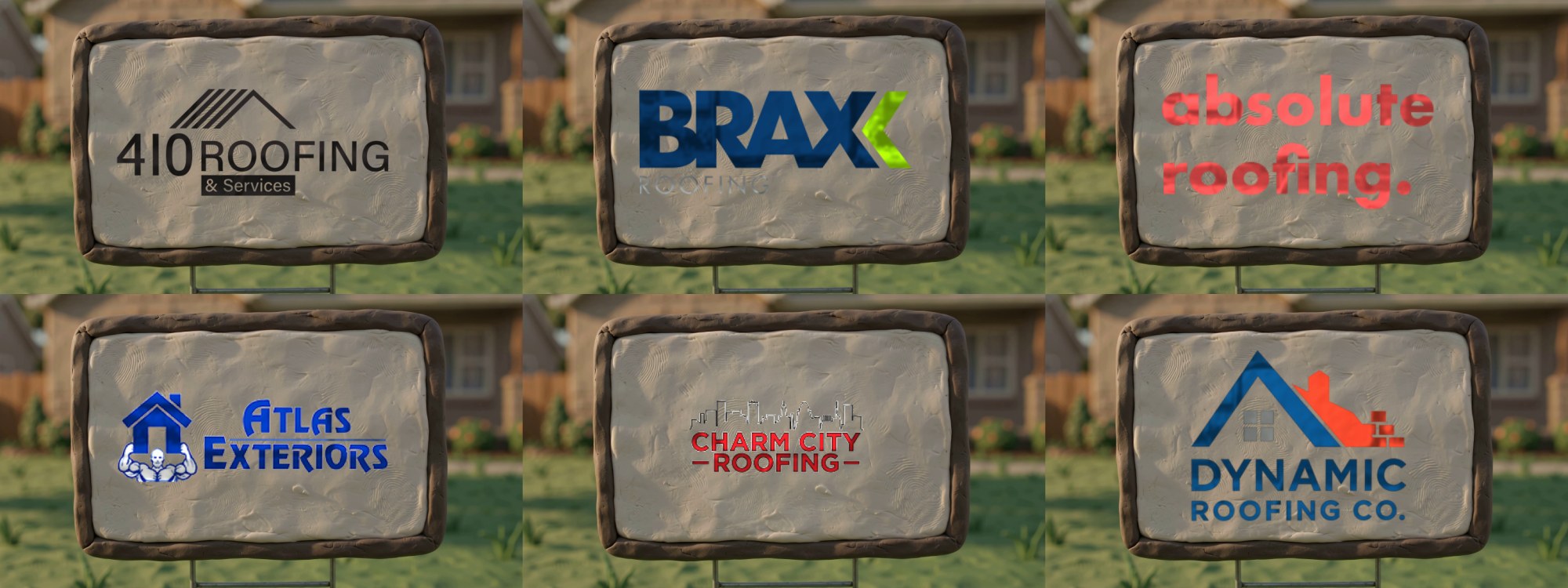
Six consecutive brands. One solved shot.
What one solved shot turns into.
Generating a hundred versions through an API costs a hundred generations. Compositing a hundred versions on your own machine costs electricity. That difference is the whole reason personalising an entire prospect list is possible rather than theoretical.
And here is one of them, start to finish.
A & B Home Improvement, eighty-five seconds. Their real logo on the truck door, the phone, the contract, the truck side and the yard sign — five branded surfaces across one cut. Every other frame in it is shared with the other seventy-one companies. Solving the shots was the work; this spot was minutes.
Farm your own
Bring your own shot and your own list.
Nothing about this is specific to roofing, or to claymation. It needs a surface and a list of brands.
- Your footage
- One clip, any length, up to 4K. Generated, filmed or animated — it does not care where the shot came from, only that the surface is visible.
- Your brand list
- A folder of logo files, one per company. Transparent artwork rides the surface directly; solid artwork gets a clean plate, so nobody's mark is background-removed by guesswork.
- Your machine
- It runs locally. That is what makes the hundredth render free, and it means the artwork never leaves your building — which matters when the artwork belongs to somebody else's company.
- Your own names on it
- Owner names, ZIP codes, phone numbers, per company. The voiceover deliberately says none of it, so one recording fits every version you produce.
Solve the shot once.
Then it belongs to every name on your list.